

Pick a Grade Level




Building curriculum in other subjects? Check out our favorite homeschooling resources.
Download Our Cheat Sheet For Free!
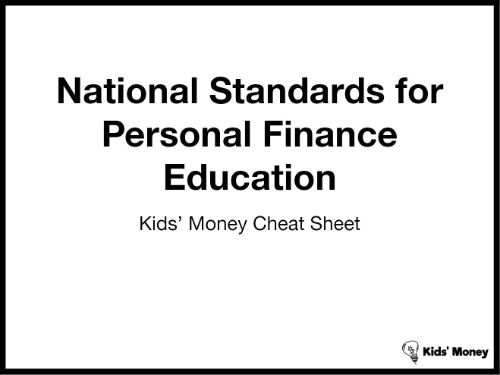
National Standards for Personal Finance Education
Our Kids' Money cheat sheet covers all objectives for every grade level in the National Standards for Personal Finance Education and the corresponding Kids' Money lesson plans that teach each objective.
What Are The National Standards for Personal Finance Education?
The National Standards for Personal Finance Education are set by The Council for Economic Education (CEE) and the Jump$tart Coalition for Personal Financial Literacy (Jump$tart).
The standards are organized around six topic areas:
- Earning income
- Spending
- Saving
- Investing
- Managing credit
- Managing risk
The standards outline learning objectives for each topic that progress from the basics to more advanced concepts as students get older.
Each objective is organized by cumulative grade level knowledge, specifying the knowledge and skills that students should have by the end of their primary (4th grade), middle (8th grade), and high school (12th grade) levels.
That doesn't mean that personal finance should only be taught in those grade levels though! These standards are meant to be cumulative based on learning happening every year.
Kids’ Money Lesson Plans cover each and every standard!
Topic Guides For Every Grade Level

Searching for lesson plans and materials on specific topics? Check out our Teaching by Topic guides! We provide learning objectives, lesson plans, worksheets, games and activities, and tips for teaching the topic at every grade level. Check out our Teacher's Guide to Teaching Money Management for tips on how to approach each topic.
- Saving Money Lesson Plans
- Earning Money Lesson Plans
- Spending Money Lesson Plans
- Sharing Money Lesson Plans
- Budgeting Lesson Plans
- Money Math Lesson Plans
- Investing Lesson Plans
- Credit Lesson Plans
- Insurance Lesson Plans
- Borrowing Money Lesson Plans
- Tax Lesson Plans
- Career Prep Lesson Plans
- Goal Setting Lesson Plans
- Entrepreneurship Lesson Plans

Featured Article
How to Incorporate Personal Finance Into Your Curriculum
Struggling to fit personal finance topics among your other subjects like math, science, and social studies? Don't sweat it! Peter Brown, a National Board Certified Teacher and long-time financial literacy instructor, walks you through exactly how to do it.
Have a Question?
Let us know! We're happy to answer any questions you have and always want feedback from teachers on new topics to cover, changes to our lesson plans, or anything else.